


Your Prospect Already Researched You. Now What?
Your prospect already researched you.
They may know what you offer. They may have looked at your competitors. They may know your general pricing range, read your reviews, checked out your LinkedIn, and spent 20 minutes asking AI questions about the kind of service you provide.
All before you say hello.
So if sharing information isn’t the point anymore, what is the sales call for?
That’s an important question, especially if you sell a high-ticket B2B service.
Because if your answer is, “Well, I need to explain everything we do,” there’s a good chance you’re spending way too much of the conversation talking.
And that may be costing you sales.
Your Prospect Already Researched You Before the Sales Call
We live in a world where information is everywhere.
My family’s fantasy football draft is a perfect example.
I do not need to be a football genius to figure out which players I should consider. I can pull up projections, rankings, injury reports, and all kinds of other information in seconds.
Give me enough data, and I can be dangerous. 😂
Your potential customers can do the same thing.
They can research your company.
They can research your competitors.
They can learn the basics of your process.
They can read reviews.
They can Google the problem they’re facing.
And now they can ask AI to summarize the options, explain terminology, compare approaches, and give them a list of questions they should ask you.
That means information is no longer the most valuable thing you bring to a sales conversation.
But that does not mean the sales conversation is less important.
I would argue the opposite.
Your Job Is to Be a Guide, Not a Presenter
If your prospect already researched you, your job on the sales call changes.
You need to spend less time being a presenter and more time being a guide.
Think about a financial advisor.
Before meeting with one, I can research:
- Index funds
- Tax strategies
- Retirement calculators
- Historical returns
- Investment options
There is no shortage of information.
But all that research still doesn’t answer the question I care about most:
What should I do with my money?
That takes judgment.
It takes understanding my goals, my circumstances, my fears, my timeline, and the decisions I’m trying to make.
Your customers need the same thing from you.
They do not need another human version of your website.
They need someone who can understand what is happening in their business and help them figure out what to do next.
The Sales Call Should Help Your Prospect Make a Decision
A sales conversation is not your opportunity to prove everything you know.
It is your opportunity to understand.
I want to learn:
- What problem is this person facing?
- Why does it matter to them?
- What have they already tried?
- What is motivating them to solve it?
- What would change if they fixed it?
- What concerns could keep them from moving forward?
- What is their timeline?
- Who else is involved in the decision?
Once I understand those things, I can connect the right pieces of what I offer to the problem they have described.
That is very different from giving the same pitch to everyone.
Your website has to speak one-to-many. It makes some assumptions because it cannot know exactly who is reading it.
A sales conversation is one-to-one.
You don’t have to assume anymore. You can ask.
And that is incredibly valuable.
What Should a Prospect Know After the Sales Call?
By the end of a good sales conversation, your prospect should know something they could not learn simply by browsing your website.
They should be able to say:
“This person understands my problem, I trust them to help me solve it, and I know what I need to do next.”
That’s the goal.
Yes, you will probably explain parts of your service.
Of course you will answer questions.
But the information you share should be connected to what you have learned about the person sitting across from you.
That distinction matters.
Instead of:
“Let me walk you through all 14 things included in our process.”
You can say:
“Based on what you just told me about your team, this is the part of our process I think would make the biggest difference for you.”
Now your explanation has context.
It has relevance.
And relevance beats volume every time.
4 Signs You’re Giving Your Prospect Too Much Information
This can be tricky when you own the business.
You’re excited about what you do.
You know how much it can help.
And once you get going...
Well, you get going. 😜
Here are four warning signs that your sales call may have turned into an information dump.
1. You’re Answering Questions They Haven’t Asked
This is one of the easiest habits to fall into.
You answer one question and then think:
“Oh! I should tell them about this too.”
Then:
“And another thing...”
And:
“While we’re talking about that, you should probably know...”
Pretty soon, you are answering questions the prospect never asked.
There is a place for explaining features and benefits.
But more information is not automatically more valuable.
Stay focused on what matters to the person in front of you.
If they didn’t ask the question, consider whether you need to answer it yet.
2. You’ve Been Talking for Several Minutes and Haven’t Learned Anything New
This is a big one.
If you have been talking for three or four minutes and have learned nothing new about your potential customer, you may be talking too much.
A sales conversation should have movement back and forth.
Think tennis, ping pong, or pickleball.
You hit.
They hit.
You respond.
They respond.
If you are standing there holding the ball and giving a TED Talk, something has gone sideways.
Good questions allow you to uncover the information you need to recommend the right solution.
And here’s something I’ve learned from a whole lot of sales conversations:
If I understand the prospect better than you do, I can beat your presentation.
Not because I’m flashier.
Because I can make the conversation about what matters to them.
3. They Start Giving You the Polite Shutdown
This one may sting a little.
Especially if you’ve walked away from calls thinking they went great because the prospect said things like:
- “Yeah, that makes sense.”
- “Got it.”
- “Sounds good.”
- “Just send me something.”
- “Wow, you were very thorough.”
- “You’ve given me a lot to think about.”
Those can be perfectly normal responses.
But they are not necessarily buying signals.
Sometimes they mean:
“I have received all the information I can handle and would now like this conversation to end.”
Sorry. 😂
Here’s how you can tell the difference.
Look at what happened afterward.
Did the conversation move toward a clear decision?
Or did they disappear?
Did the process drag on for weeks?
Did you send the proposal and never hear from them again?
If you regularly hear those polite responses followed by ghosting, there is a good chance your prospects are leaving the call with plenty of information but no greater clarity about their decision.
4. You End the Call Missing Important Information
This is one of the clearest tests.
After your next sales call, ask yourself:
- Do I know what is motivating them to buy?
- Do I know their timeframe?
- Do I know who else is involved in the decision?
- Do I understand what could stop them from moving forward?
- Do I know what happens next?
If you don’t know those things, but you spent 30 minutes explaining everything about your company...
You probably talked too much.
We can get so focused on what we need to say that we fail to make room for the information we need to hear.
And the information you hear is what allows you to make the rest of the conversation useful.
Stop Assuming and Start Asking
This is one of the biggest opportunities I see with B2B service providers.
If you have a one-on-one conversation with a potential client, don’t hide behind the presentation.
A pitch deck has a place.
A beautiful website has a place.
Great marketing has a place.
But when another human being is sitting in front of you, take advantage of that opportunity.
Ask.
Listen.
Clarify.
Understand.
Then recommend.
A simple rhythm looks like this:
Listen
Give your prospect room to explain what is happening.
Recognize
Pay attention to the problems, frustrations, motivations, and goals underneath what they are saying.
Clarify
Don’t assume you understand. Ask follow-up questions and make sure you have it right.
Recommend
Once you understand their situation, connect the pieces of your service that are relevant and explain the appropriate next step.
Notice what’s missing?
The 27-minute company presentation.
You’re welcome. 😜
Your Website Can Give Information. Your Sales Call Should Build Trust.
This is why I believe good sales conversations become even more important as AI makes information easier to access.
Your prospect can use technology to learn a lot.
But when they are considering a significant investment, especially a high-ticket B2B service, they still have to decide:
Do I trust this person to help me?
Marketing can start that process.
Your website can establish credibility.
Your content can demonstrate expertise.
AI can explain concepts.
But there comes a point when your prospect needs to interact with you.
They need to experience whether you understand them.
They need to hear how you think.
They need to feel confident that you are recommending something because it fits their problem, not simply because it is what you happen to sell.
That is what the sales conversation is for.
The Better Question Isn’t “What Should I Say?”
A lot of business owners prepare for sales calls by asking:
What do I need to say?
I want you to add another question:
What do I need to understand?
That one shift can change the whole conversation.
Because there are always two conversations happening on a sales call.
There is the conversation you are having out loud.
And there is another conversation happening inside your potential customer’s head.
That second conversation is where the buying decision is being made.
If you spend the entire call talking, you never get to hear enough of it.
And when your prospect already researched you, hearing that conversation may be one of the most valuable things you can do.
Want to Have Better Sales Conversations?
If your sales calls tend to turn into presentations, information dumps, or conversations that feel great but still don’t result in a decision, I can help.
In my six-session Sales Lab, we’ll work together one-on-one to help you lead purposeful, authentic sales conversations.
We’ll look at how you listen, what you ask, what you say, and how you help potential customers make a clear buying decision without becoming pushy or turning into someone you’re not.
Because you don’t have to be a jerk to be good at sales.
Schedule a call with me and let’s talk about your sales conversations.
Here’s to valuing your customers and making more sales.
Your prospect read your website, checked your competitors, and looked at your reviews. Then they booked a call. What do they need from you that another Google search can’t give them?
If your answer is a longer explanation of your services, you may be talking your way into “Thanks, you’ve given me a lot to think about.” Followed by silence.
Episode Summary
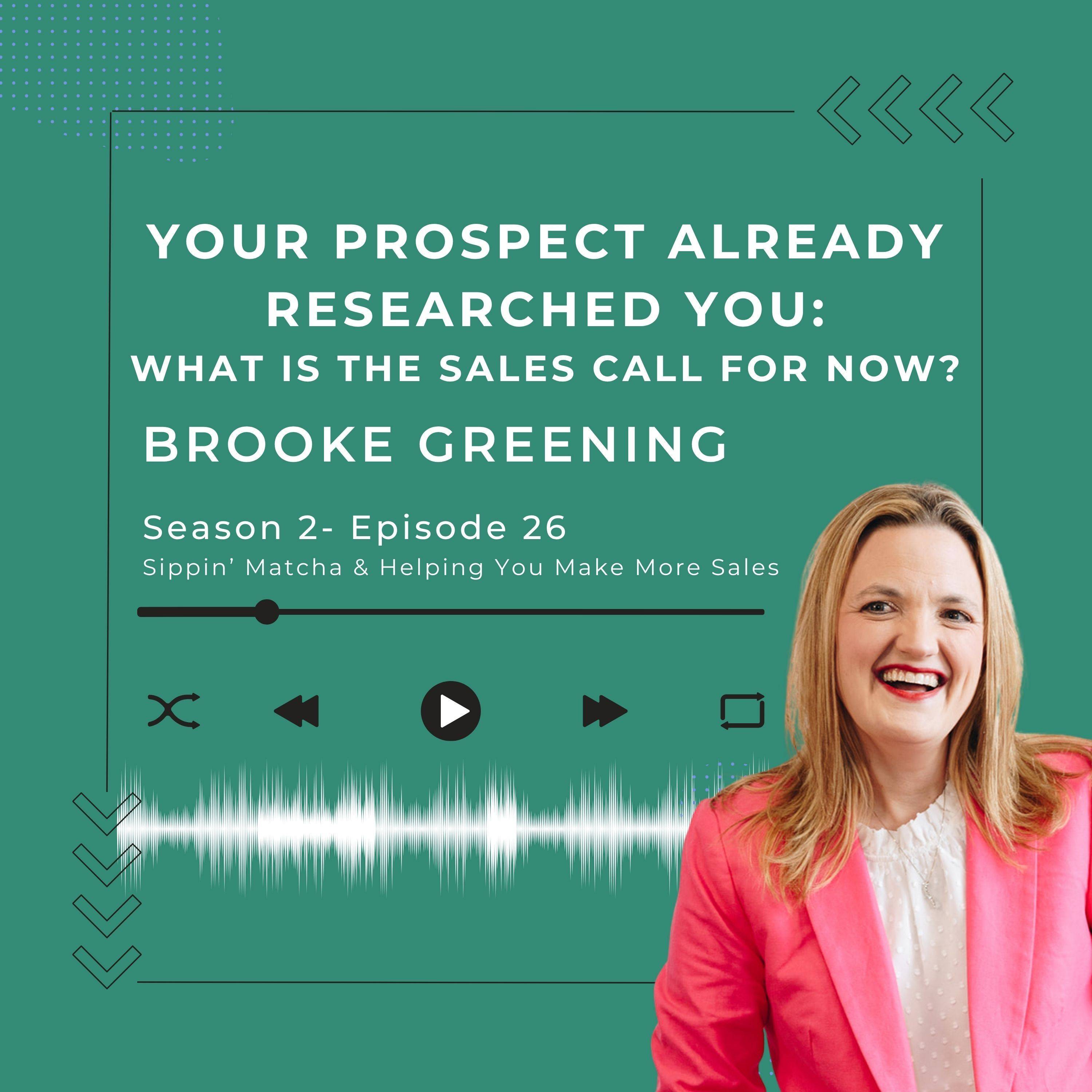
In this episode of Sippin’ Matcha and Helping You Make More Sales, Scott and sales coach Brooke Greening explore how informed B2B buyers change the purpose of a sales conversation.
For business owners, consultants, and service providers selling higher-ticket services, the call is an opportunity to understand the prospect’s situation, build trust, and help them make a buying decision. Brooke explains how to guide that conversation, connect your expertise to their specific problems, and spot four signs you’re sharing too much information.
Along the way, Scott and Brooke bring in fantasy football, a museum bathroom emergency, and the famously drawn-out Midwest goodbye. Because even a polite conversation can be going nowhere.
What You’ll Learn
- What a sales call is for when buyers have already done their research: Help prospects apply information to their situation and decide how to move forward.
- What your website can’t settle for them: Whether you understand their problem and whether they trust you to help.
- Four signs you’re explaining too much: Answering questions they haven’t asked, learning nothing new, hearing polite shutdowns, and ending the call without key buying details.
- Why “just send me something” can signal disengagement: How to recognize the pattern when friendly responses lead to stalled decisions or ghosting.
- What to uncover before the call ends: Their motivation, buying timeframe, and who else is involved in the decision.
- How to make your expertise relevant: Listen, recognize the problem, clarify what you heard, and recommend a next step.
Resources Mentioned
Six-Session Sales Lab with Brooke Greening
Want help leading purposeful, authentic sales conversations?
Explore Brooke’s one-on-one coaching and learn how to understand what prospects are thinking, communicate your value, and guide buying decisions.
Join the Conversation / Subscribe
Have you ever heard “You’ve given me a lot to think about” and then nothing? We’d love to hear your experience.
Listen and subscribe on your favorite podcast platform.
Follow the show for the next episode on how to lead a sales conversation toward a buying decision. If this episode helped you, leave a review or share it with another business owner.
Connect with Brooke on LinkedIn
Keep the conversation going with practical advice for making sales feel more human.
Connect with Brooke Greening on LinkedIn
Your Prospect Already Researched You: What Is the Sales Call For Now? | Chapters
00:00 What Is the Sales Call For If Buyers Already Researched You?
01:18 The Changing Reality of B2B Sales
03:18 Why Buyers Know More Before the Sales Call
03:46 Stop Presenting—Start Guiding the Buyer
04:34 Information vs. Advice: What Buyers Actually Need
05:16 The Real Purpose of a Sales Conversation
05:44 What Prospects Need to Know Before They Buy
07:20 Why Human Trust Still Matters in the Age of AI
08:25 Are You Talking Too Much on Sales Calls?
09:45 Stop Pitching and Start Asking Better Questions
11:05 The “Polite Shutdown” Most Salespeople Miss
12:45 Why “Send Me Something” Isn’t Always a Buying Signal
13:40 The Key Sales Information You Must Uncover
14:40 Listen, Clarify and Recommend the Right Next Step
15:35 How to Lead Buyers Toward a Confident Decision
Your Prospect Already Researched You: What Is the Sales Call For Now? | Full Transcript
Brooke Greening: Your prospect may know your services, your competitors, the pricing range, reviews, and even your philosophy before you even say hello.
So if sharing information is not the point, what exactly is the sales call supposed to
accomplish
If you're going- if they're going to work with you, they have to be able to know you and trust you, and the website is not going to do it.
Scott Greening: But the one thing that AI, I think is always going to struggle with is building trust with a human, like human to human trust.
And so, uh, that's what sales conversations are really about is building that trust.
Brooke Greening: So another sign is you've been talking for several minutes, and you haven't learned anything new.
That is a big red flag that you are giving way too much information.
If I understand where they're at and the problems that they're facing, and I've been able to uncover those things that are driving them and motivating them, I am going to beat you in every TED Talk that you give them.
Those are not buying signals. That is a polite way of them wanting to kind of shut things down, and it's been an information overload at that point.
Just ask yourself, if you've had a conversation, they have said those things, and it didn't result in a sale, and either you felt like you got ghosted or it just kept going on forever and ever, that is when you know it, they were politely shutting you down.
Scott Greening: Hey everyone. Welcome to another episode of Sippin Matcha and Helping You Make More Sales. Where in about the time that it takes you to enjoy your matcha or coffee break, our sales expert, Brooke Greening, gives us some great advice on our sales conversations.
Because if you have to talk to people to make more sales or to make sales, how well you lead those conversations is going to make or potentially break your revenue. And Brooke, we're starting a new series today, five episodes or so, on some of the changing realities of B2B purchasing-
Brooke Greening: Mm-hmm ...
Scott Greening: service providing businesses especially.
And things are changing and we're going to talk about that today. It has to do with information. And one place that this reality shows up, like for us, it's football season, so we just had- ... our family fantasy football draft.
Brooke Greening: Oh my word. It takes forever because there are so many family members. It takes hours and hours, and trying to keep everybody focused is a little bit of a, little bit of a hassle.
But it's fun. We do it every single year. And so yeah, we have our fantasy footballs. My team is called Chasing Your Dreams 'cause I have Ja'Marr Chase as-
Scott Greening: Yep ...
Brooke Greening: my head one.
Scott Greening: Yeah, so our kids are participating, that's why it takes in part so long, and that- And the reality is, like I enjoy football, I watch a good amount of football, but I am not a fantasy football expert.
But what I can do is look up on the internet and have it tell me who I'm supposed to draft.
Brooke Greening: Yeah, and you don't even actually have to do a ton of looking up. So like on our Yahoo account or whatever, I can literally see, okay, these are the points they're projected to make. This is, and it says it in really big red letters if they're hurt or if they're ha- if something happened or if they're not playing that week.
And so I can very, very quickly get enough information to be dangerous in regards to choosing who's going to be playing that week for fantasy football. And it's the same with people when they're having our sales conversations.
Scott Greening: Yeah, it's the, it's the same thing. People can find out a fair amount about us, our businesses, our services, what we do, before they even get onto a conversation with us.
So let's talk about that today. If buyers already know a lot about us, what is the salesperson's job? What's the role of having a sales conversation?
Brooke Greening: So it's less and less about being a presenter and more like being a guide. And so we're going to start talking today in regards to, okay, so if they already know information, how do we lead this conversation?
What's the point of what our sales conversation is going to be? And I just wanna encourage you as we keep talking through this, this is not about sharing more information. We're not a billboard. We're going to have a real conversation and be the guide in helping them to come to a buying decision. That is the goal.
Scott Greening: All right, Brooke. I know sometimes when it's our own business, we kind of lose sight, and we're s- we're so excited about what we do and all that, we know how much it can help that we kind of get into this, like, information sharing idea. But is there an example of, like, someone where, that you can flesh this out, where somebody can find something, a lot of information, but they still need to have the sales conversation?
Brooke Greening: Oh, 100%. Let's just maybe talk about a financial advisor. So from the potential client's perspective, you can look up index funds, you can look up tax strategies, retirement calculators, like historical returns, all of those things, but it actually doesn't answer the question that they need to know when they're talking with the sa- with the financial advisor, which is, "What do I do with my money?"
Scott Greening: Yeah, and I think what happens is, like, information is abundant. It... You can find it anywhere, but knowing the wisdom, the g- the good judgment of what to do with that information is actually pretty rare. And so that's where the salesperson, that's where service providers can come in and really help people take the steps forward that they wanna make.
Brooke Greening: Yeah. A sales conversation is not meant to be like this billboard of proving to them everything that you know. It is all about understanding where they're at, the frustrations they're facing, and if you can be able to help them, and what those next steps are going to look like.
Scott Greening: All right. So that's good conversation.
There's still a role for sales, whoo- ... otherwise we'd be out of a job. But then let's ask another r- related type of question. They can find out all this information, but what should a prospect, what should a potential customer know at the end of a sales conversation that they couldn't learn from our website?
Brooke Greening: So the biggest thing that they need to know, and they also need to believe, is because now they are trusting you, that you can be able to help them with the problems that they're facing, and you're now sharing with them what they need to do next in order to keep moving that forward. And our website does not usually share that type of stuff, because we don't know the problems that they're facing.
A website is just, boom, this is what we're doing, and we're trying to sell one to many at that point. When we're in a conversation, that's when we don't have to guess anymore, we don't have to assume what's happening. The whole point is to be able to uncover what problems they're facing and to see if we can help them with that.
If we can, great, then we're going to start talking about what we need to do next to keep working through solving that problem.
Scott Greening: Yeah, so people want- And so- People wanna know, like, you're, you understand them. They wanna know, "Oh, I trust this person. Oh, I, I'm beli- I'm even excited that they can help me with this."
I cut you off. What were you going to say?
Brooke Greening: I was just going to say, I know we were just joking and saying, "Oh, whoo, there's a place for sales," uh, because sometimes people are like, "Is AI going to take over absolutely everything?" But it is- Even more abundant that there is a place in regards to sales conversations, especially when we're talking about these higher ticket investments, especially in B2B, that they have to have.
If you're going- if they're going to work with you, they have to be able to know you and trust you, and the website is not going to do it. You can't... It's a great first step. It's a great way to get them to start having a conversation with you, but you can't just use your marketing trying to get to your sales goals, especially if they have to talk to you in order to decide, yes, we're going to move forward, we're making this investment, we're getting contracts going, all of those pieces.
So it's even more important that we have good sales conversations in this AI stage.
Scott Greening: Yeah, we're going to do- And one- ... I think, a, a little deeper dive on AI in a couple of, of episodes and the, the pluses and minuses. But the one thing that AI, I think is always going to struggle with is building trust with a human, like human to human trust.
And so, uh, that's what sales conversations are really about is building that trust. Yeah. So what are some signs that you might be explaining too much? Like you're doing too much of an information dump.
Brooke Greening: Yeah ...
Scott Greening: what does that look like?
Brooke Greening: I would say the very first sign is you're answering questions they haven't asked.
That is a big thing. So like, and then you're like, "Oh, oh, and another thing about this," or, "We can talk about this," or, "Hey, this is, this is also a part of it," that's often a warning sign. There are times and places. I am not saying we do not share in regards to how we can help with those features, benefits.
Like, I'm not saying those are evil, but I am saying specifically in our sales conversations, we tend to overload way too much. And so if they haven't asked, we need to just continue to keep s- focusing on them and what's going on with the problems they're facing, what's going on with the questions they're asking.
That's the most important thing.
Scott Greening: Yeah. It's sort of like if we had our youngest one along with us at a museum, and we were a- asking the, the tour guide like, "Where's the restroom?" And they said- ... "Well, I can tell you, but before I do that, let me tell you about this Renaissance painting and the archit- why we set up this room like this."
And I'm like, "Okay, that's great." Um, she's gotta pee. So let's- ... Let's
Brooke Greening: get that- Let's keep going.
Scott Greening: Yep, that's right. Yeah. All right. So what's another sign? So it we're answering questions that they haven't asked. What's another sign?
Brooke Greening: Yeah. So another sign is you've been talking for several minutes, and you haven't learned anything new.
That is a big red flag that you are giving way too much information. We are supposed to have good questions so that we can learn what's going on with them. The, so many times we think, "Well, they have to know all of this stuff about me before they'll make the decision." That's not actually true. They need to be able to trust you, and the only way they can do that is when you know more about them and what they're facing and then can clearly share how you're able to help.
So if you're talking and you haven't learned anything new about them, and it's been three, four minutes, you're sharing too much.
Scott Greening: Yeah. We w- a conversation has two sides, right? So it's-
Brooke Greening: Mm-hmm ...
Scott Greening: like pickleball or tennis or ping pong or like there's back and forth you want to go, and it's, it's really easy to sort of default into one person talking, um, and lose that, that interaction, uh, which then people stop engaging and trusting and all of that.
Brooke Greening: Yeah. And so many times, and I've worked with different clients like this, where they have like a pitch deck ready to go and all of that, and I'm not saying any of that is wrong. But when we're having a conversation with the person that can actually make the decision, and it's like a one-on-one. We're not in a boardroom, and we've got a bunch of people that we're talking to.
We're giving ourself a disservice when we're trying to hope that our marketing is going to make the sale for us. We're literally treating it as, " I'm just going to keep talking at you," instead of understanding where they're at. If I understand where they're at and the problems that they're facing, and I've been able to uncover those things that are driving them and motivating them, I am going to beat you in every TED Talk that you give them.
And it's not because I've had 90,000 sales conversations. It's because that's what's important to them, and it's the same thing I teach my clients. All of these things have a place, but when you have a one-on-one conversation, don't hide behind some presentation, because that's assuming we know the problems that they're facing, and that's assuming we have all of the answers for them, and we don't want to do that.
When you have a one-on-one, stop assuming and start asking and understanding where they're actually coming from.
Scott Greening: All right, so that's the... We're, got a couple of signs here of the dangers of information dump. What's another sign that you are dumping too much information?
Brooke Greening: They give you the polite shutdown.
And I'm going to share this, and people are going to maybe stop their cars or whatever, and they're going to be like, "Wait a minute. That's a polite shutdown?" Especially in B2B, there's not very many jerks out there, and I greatly appreciate that, 'cause I have been in some other industries and you're like, "Holy cow," "that was not a fun conversation."
That is not really where we're at, especially when we're talking about higher investments. But when they start saying things like, "Oh, yeah, that makes sense. Got it. Yeah, okay, sounds good. Hey, just send me something. Ooh, wow, you were very thorough. You've given me a lot to think about," those aren't actually...
Those are not buying signals. That is a polite way of them wanting to kind of shut things down, and it's been an information overload at that point.
Scott Greening: Yeah, I know that sort of the, the typical... So we're both have Midwest roots, and so I think sometimes our East Coast friends and family, like, our goodbyes are very polite and sort of drawn out.
But we're, we're still saying goodbye. And, uh- Right ... sometimes that happens on, sometimes that happens on sales calls when you've shared too much information and people have checked out, and they're like, "All right, I gotta move on. You need to-
Brooke Greening: Yeah ...
Scott Greening: to wrap this up."
Brooke Greening: And I do, I do wanna share quickly that it's not every time you hear that, that is a bad thing.
That is not what I am saying. But if... This is where you can kind of know, is she actually right in what she's saying, or is this not pertaining to me? Just ask yourself, if you've had a conversation, they have said those things, and it didn't result in a sale, and either you felt like you got ghosted or it just kept going on forever and ever, that is when you know it, they were politely shutting you down.
It was too much information. We didn't uncover the problem. And so they're just looking at it again, like, "Hey, this is more of just information gathering, not helping me actually make a decision."
Scott Greening: So then what's the, the last sign that you've got for us on how to know that we may be dumping too much information?
Brooke Greening: You've ended the call and you have missed key information. Meaning, okay, we don't actually know what's motivating them to buy. We don't actually know what their timeframe is. We don't know who other decision-makers are. Like, there are key pieces that we need to know that we, if we would have taken time and to be able to, to take a breath and be able to ask those questions instead of focusing so much on what we're saying, that's how you know.
So when you get off of a call and you're like, "I don't actually know if they're going to move forward. I don't know what their buying timeframe is. I don't know who else is involved in these decisions," that is a key indicator we talked too much, and we weren't able to give them space to be able to share what they needed to.
Scott Greening: All right, so we've been talking about this theme of there's so much information out there, and that we shouldn't be information dumping. If we're not supposed to be spending the call explaining our products and services- ... In brief, what are we supposed to be doing instead?
Brooke Greening: And to be clear, it's not that we don't explain it all, but we just need to explain the pieces that are important to help connect with the problems that they were sharing with us.
But just as a quick example, you want to be able to listen. You want to be able to recognize what's going on with them, the problems that they're facing. We want to clarify, make sure we're not assuming things, that we do have it right, and then we can start recommending what those next steps are and how to be able to work with us.
Scott Greening: All right, everyone. We're exploring this theme about sales not being just dumping information. And the reality is, is that there are two parts to every sales conversation. There's the part that you say, but then there's the part that's going on. There's the conversation that's happening in your potential customer's mind where they're actually making the decision.
And if you don't hear that part, what you say is going to be much less relevant to the, the sales conversation. And that's where Brooke's 90,000 sales conversation and her master's in counseling come into play and can help you make more sales. Brooke has a six-session sales lab where she'll lead you through learning how to both listen and say the things that will lead people to the buying decision and not just dump information.
So if you want to explore what that looks like, you can go to buildingmomentum.info/meet and set up a call with Brooke that fits your schedule, and she can help you have these purposeful, authentic conversations that will make more sales
Brooke Greening: All right, so this has been a great conversation and I can't wait till next week because then we're going to start talking about, okay, so if I'm not supposed to give them a bunch of information, then how do I actually lead them in a sales conversation to them being able to make the decision to buy? So join us next week, and that's what we're going to be talking about.
Scott Greening: So if you wanna make sure that you don't miss this conversation, we encourage you to go to buildingmomentum.info/matcha where you can find the links to the podcast on all of your favorite platforms.
We love hearing from you. We love it when you like and review and follow and do all of those things. You can find that again at buildingmomentum.info/matcha.
Brooke Greening: And remember, when you're ready to make some more money, call Brooke
Recent Comments